Noom App Review: What It Costs and How the Billing Really Works
A note on scope before we start. Noom is a weight management app, and whether any such programme is right for you is a conversation for you and a healthcare professional, not a review site. So this review stays on ground we can actually verify: what Noom is, what it costs, how the billing works, how cancellation works, and what the much-quoted lawsuit actually was.
That last point needs correcting immediately, because almost every article gets it wrong.
First, the correction: there was no FTC settlement
You will read everywhere that Noom settled with the Federal Trade Commission for $62 million. That is not what happened.
It was a private class action, not an FTC enforcement action. The case was Nichols et al. v. Noom, Inc., in the US District Court for the Southern District of New York, docket 1:20-cv-03677-KHP.
| Detail | Fact |
| Type of case | Private class action brought by consumers, not a regulator |
| Amount | $56,000,000 cash plus $6,000,000 in subscription-fee credits, which is where the $62 million figure comes from |
| Class period | US purchasers of an auto-renewing Noom Healthy Weight subscription via Noom's site or app, 12 May 2016 to 6 October 2020 |
| Excluded | Apple iTunes and Google Play purchasers |
| Payouts | Around $167 for subclass A, around $30 plus one free month for the first 100,000 valid claimants in subclass B |
| Final hearing | 11 July 2022. The settlement is closed |
| Admission | Noom admitted no wrongdoing and maintains its practices were lawful |
We searched the FTC's legal library and ran site-restricted searches on ftc.gov. No Noom enforcement case exists there. If you see an article claiming an FTC settlement, it has confused the two.
What the lawsuit actually alleged
- A two-week risk free trial that auto-enrolled users into a paid membership
- Auto-renewal terms that were disclosed but, the plaintiffs argued, not clearly or conspicuously enough, with no explicit consent to renewal
- Cancellation that required messaging a coach, which was a bot, which then redirected users to cancel via iTunes or Google Play
- Difficulty avoiding charges or getting refunds
Noom agreed to a two-year set of changes: substantially enhanced auto-renewal disclosures, a separate affirmative action such as a checkbox to accept auto-renewal, and a cancel button on the customer account page. That two-year commitment has since expired.
What Noom actually is
| Founded | 2008 by Artem Petakov and Saeju Jeong. The app launched in 2016 |
| Headquarters | Princeton, New Jersey, moved from New York City in 2025 |
| Leadership | Geoff Cook is CEO. Jeong is Executive Chairman, Petakov heads Noom Ventures |
| Ownership | Private. Last valuation $3.66 billion at Series F in May 2021 |
| Financials | None published. Noom has filed exactly two documents with the SEC, both Form D, in 2014 and 2015. No 10-K, no S-1, no audited figures exist |
That last row is worth pausing on. Any revenue, subscriber count or profitability figure you read about Noom in 2026 is a company statement, a press leak or a third-party estimate. None of it is audited, because Noom has never had to publish audited accounts.
The product itself
- A colour food system: green, yellow and orange, based on calorie density. Noom changed red to orange in 2021. Green foods fill you up for fewer calories, orange is the opposite. Noom's own line is that no food is off limits
- Daily lessons of 5 to 15 minutes from day one, based on cognitive behavioural therapy plus elements of DBT and stress management. They cover sleep, stress and self-care, not only food
- An onboarding quiz of 50 plus questions, taking 10 to 15 minutes, which produces a plan typically around 16 weeks with a suggested daily calorie range
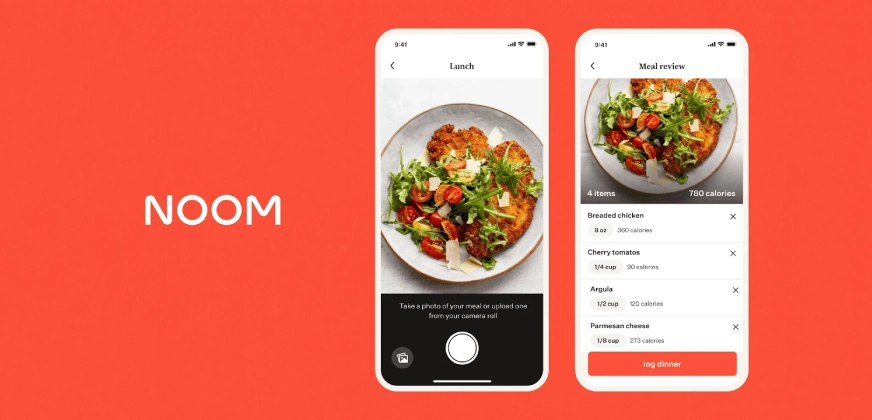
- Food logging, including AI photo, text and voice logging added in June 2024. Optional daily weigh-in. A pedometer starting at 200 steps per day
- Integrations with Apple Watch, Fitbit, Garmin, iHealth, Misfit, OMRON, Polar, Qardio, Runkeeper, Withings and YOO. Plus water, glucose and blood pressure tracking, and over 1,000 recipes
The coaching model has changed, and this matters
Noom's current copy says your coach will check in every week or more often if you prefer, and that you can message your coach 24/7 through the app.
In June 2024 Noom launched Welli, an AI health assistant chatbot available 24/7. Noom's own framing is that Welli complements the human coaching experience, with the CEO saying Noom will use human coaches for accountability and connection and AI for always-on access.
Here is the part worth knowing before you buy. That same announcement states Welli is what enabled Noom to add 1-to-1 direct message human coaching to its Premium tier. And Noom's own billing FAQ lists Premium Subscription, which includes 1:1 coaching and meal and exercise plans, as a paid add-on billed separately on its own cycle.
So 1-to-1 human coaching is an upsell, not part of the base Noom Weight price. Noom does not publish the Premium add-on price anywhere we could find, which is its own transparency gap.
What Noom costs
Every plan auto-renews and every plan is billed upfront as a lump sum. Prices exclude tax.
| Plan length | Total charged upfront | Effective per month |
| 1 month | $70 | $70.00 |
| 2 months | $129 | $64.50 |
| 3 months | $159 | $53.00 |
| 4 months | $169 | $42.25 |
| 5 months | $174 | $34.80 |
| 6 months | $179 | $29.83 |
| 8 months | $189 | $23.63 |
| 10 months | $199 | $19.90 |
| 12 months | $209 | $17.42 |
Read the middle column, not the right one. Noom's marketing leads with $17.42 a month. What actually happens is a single $209 charge on your card. Noom says most users start with the 4-month plan, which it advertises at $42.25 a month and which is a one-time $169 charge.
Noom's own wording confirms it: currently, all plans are billed upfront. Its terms define Billing Period as the interval between recurring billing dates corresponding to the term of your subscription, so a 4-month plan is one billing period charged once at the start.
The trial is not free, and that is by design
Noom's exact copy: Noom Weight has a trial period of 7 or 14 days. Then this:
"It costs us approximately $10 to offer a 7-day trial, so when you start out, we give you the option of choosing a price for your trial that you think is reasonable. For example, some options to choose for a 7-day trial might include $0.50, $3, $10, or $18, among others. Many people decide to pay for a trial."
So it is pay what you think is fair, with Noom setting the anchor points. The trial includes nearly all paid features.
The mechanic to understand: you select your multi-month plan before the trial starts, and the full upfront lump sum hits when the trial ends. Noom's terms, section 6.3(a), state that you will not receive a separate notice that your free trial is about to end or has ended, or that your paid subscription has begun, unless required by law.
Renewal, and the clause worth setting a reminder for
At the end of your term the plan auto-renews for another full term at the then-current price, charged again as a single lump sum. Terms section 6.5:
"If you do not timely cancel your subscription, your subscription will be renewed at the price in effect at the time of the renewal, without any additional action by you, and you authorize us to charge your payment method for these amounts."
Noom's billing FAQ adds: if you've finished your program but still have an active subscription, billing will continue unless you cancel.
Put those together. A 12-month plan that is not cancelled produces another $209 single charge a year later, with no pre-renewal notice by design, and renewal charges are explicitly non-refundable. If you buy an annual plan, put a calendar reminder for day 360. That single habit is the most useful thing in this review.
Cancelling: this genuinely got fixed
Credit where it is due. The worst allegation in the class action, that there was no self-service way out and cancellation was gated behind a bot, no longer applies.
Noom's current support article says plainly: you can cancel either right in the app, on the web via the Subscription Portal, or through your device's app store.
1. In-app: profile picture at top-left, then Settings, then Manage Subscription, then follow the prompts
2. Web: sign into the Subscription Portal, then Cancel Subscription
3. App store: if you subscribed through iOS or Android, cancel there
Two details from the same page: uninstalling the app will not cancel your subscription, and cancelling does not end access immediately. You keep full features until the current billing cycle finishes.
The deadline: Noom's terms require you to cancel before 11:59pm Eastern on the day before your next recurring billing date to avoid the next charge.
Refunds, where Noom's own documents disagree
This is the one area that still deserves a flag.
Noom's binding Terms of Service, section 6.13, say: California residents may cancel and seek a refund per section 6.7. In all other instances, all fees and charges assessed by us are non-refundable except as expressly promoted by Noom.
Noom's help centre says something different:
- For Noom Weight, initial subscription or add-on charges may be eligible for a refund if you reach out within 14 days of purchase
- Renewal charges are not refundable
- For Noom Med, refunds may be available until a prescription is written, and not after
- For telehealth for branded medications, within 7 days of first charge, only if no clinical visit has occurred
The gap: the binding terms say non-refundable, the help centre says 14 days. And the 14-day refund is discretionary and not self-service. You have to open a chat or a contact form and support will confirm eligibility. Contrast that with the one-click cancel, which is self-service.
California residents get a separate right: rescind within 3 business days, excluding Sundays and holidays, by mailing a signed, dated notice to Noom's legal department in Princeton. Note that this is a postal mail requirement in 2026.
Noom Med and the GLP-1 side
Noom still offers medication support, and prices vary considerably by programme. These are from Noom's published pages and exclude tax.
| Programme | Price as listed |
| GLP-1Rx Program | $129 initial 4-week supply, then $279 per month, medication included |
| Microdose GLP-1Rx | $99 first 4-week supply, then $597 every 12 weeks, which is $199 per month, medication included |
| Proactive Health Microdose GLP-1Rx | $149 per month on a 4-month subscription, billed in monthly installments |
| Telehealth for branded medications | $69 for a 30-day trial, then $99 per month. Medication NOT included. Not available in all states |
Noom's own pages are inconsistent here. The FAQ quotes lower entry points, starting at $79 for microdose and starting at $39 for branded access, with a footnote saying new pricing for new accounts only effective as of 31 March 2026. Treat Noom Med pricing as a range and get a quote for your own situation rather than relying on any single published number.
On compounded medication, we will quote Noom's own disclaimer rather than characterise it: if your clinician feels compounded medications are clinically appropriate for you, any compounded medications are not approved by the FDA or reviewed for quality, safety or efficacy. And: the FDA does not review any compounded medication for safety or efficacy.
Noom has publicly taken a position on this, running a full-page Wall Street Journal advertisement advocating for policy changes on compounded GLP-1s. Anything involving prescription medication is a conversation for you and a clinician, not a review site, so we are reporting what Noom publishes and leaving it there.
Ratings, and what people actually complain about
| Platform | Rating | Volume |
| Apple App Store | 4.7 out of 5 | 872,883 ratings |
| Google Play | 4.05 out of 5 | 314,315 ratings |
| Trustpilot | 4.5 out of 5 | 67,081 reviews |
| BBB | A+, accredited since October 2021 | 625 complaints in 3 years |
The 0.65 point gap between iOS at 4.7 and Android at 4.05 on the same product is itself interesting, and nobody has explained it.
One BBB detail worth quoting: BBB's own notice on the Noom profile says it publishes only about one in five complaints handled through conciliation due to the high volume of complaints received for this business. So 625 is a published subset, not the total.
BBB's complaint categories break down as: product issues 273, service or repair 161, billing 90, sales and advertising 49, order 30, customer service 13, delivery 9. Historically, BBB issued a public consumer warning about Noom in 2020 over cancellation and refund difficulty. Noom became BBB accredited with an A+ in October 2021, after that warning.
The themes
- Refunds and cancellations, with users who cancelled shortly after purchase getting partial refunds or being told the charge could not be reversed
- Billing, including charges without a clear reminder, undisclosed pharmacy fees, and lab work charges users say they were told would be covered
- Medication delivery, a newer theme, with shipments delayed, arriving warm, or not arriving at all
- Advertised terms differing from actual delivery times and included costs
- Lack of help with insurance documentation
The pattern is consistent and it is the honest summary of this review: complaints cluster on billing, cancellation, refunds and medication logistics, far more than on the lessons, the colour system or the app itself. A 4.7 App Store rating sitting alongside heavy billing complaints is what it looks like when people like the product and dislike the commercial machinery around it.
The evidence base, stated accurately
Noom maintains a public publications list of roughly 50 entries spanning 2016 to 2025. The volume is real. Noom is not a company with no literature behind it.
But the large majority are retrospective analyses, observational studies, cross-sectional surveys, single-arm studies and secondary analyses of Noom's own user database, rather than controlled trials. Several genuine randomised controlled trials do exist, including ones on diabetes prevention, binge eating and various clinical populations. Most of those are small or pilot scale, some in narrow groups such as pancreatic cancer or colorectal polyp patients, with one diabetes RCT at n=40.
The 2026 trial
Noom's largest ever RCT was announced in June 2026 and published in Obesity Science and Practice. The details, stated plainly:
- Fully remote RCT, 16 weeks of Noom Weight against a 16-week educational control based on US Dietary Guidelines, then 52 weeks of follow-up
- n = 427 adults, mean BMI 32.5, 83% women, 24% non-White or Hispanic
- Funded by Noom, Inc. ClinicalTrials.gov NCT06666842
- Noom's stated limitations include that body weight was self-reported via the app rather than clinic-measured, and that the sample was 83% female, limiting generalisability
The fair characterisation: the body of evidence is substantially company-funded or company-affiliated, predominantly observational, and the controlled trials are mostly small or in narrow clinical populations. That is not the same as saying it does not work, and we are not making any claim either way. It is a statement about the quality and independence of the evidence, which is something a buyer is entitled to know.
Price comparison
Price and model only. No comparison of outcomes.
| Service | Price | Model |
| Noom Weight | $70 for 1 month to $209 for 12, billed upfront | Lessons, colour food system, logging, coach check-ins. 1:1 coaching is a paid add-on |
| MyFitnessPal Premium | $79.99 per year or $19.99 per month | Calorie and macro tracking, barcode and voice logging, ad-free. No coaching |
| Lose It! Premium | Around $39.99 per year, lifetime option at $49.99 to $59.99 | Calorie counting, food database, photo logging. No coaching |
| Simple | App store tiers from $14.99 to $59.99 | AI coach, fasting plus food logging, photo meal scoring. AI-led, not human-led |
| WeightWatchers Clinic | $25 first month, then $74 per month on a 12-month plan. Medication not included | Points system plus clinician-guided medication |
| Found | $99 per month with insurance, $169 cash pay, per 28-day cycle | Clinician-led medical weight loss |
Worth knowing for context: WW International filed Chapter 11 on 6 May 2025 and emerged on 24 June 2025, eliminating around $1.15 billion of debt through a 42-day prepackaged plan. WW stated there was no change to member offerings. Coverage widely attributed the filing to GLP-1 drugs disrupting the behavioural weight-loss market.
The regulatory backdrop in 2026
Since this whole review is about subscription mechanics, the current state of the law is relevant.
- The FTC finalised its Click-to-Cancel amended Negative Option Rule in October 2024
- The Eighth Circuit vacated it in July 2025
- The FTC restarted rulemaking with an advance notice of proposed rulemaking in March 2026
So there is currently no operative federal click-to-cancel rule. Subscription cancellation is governed by state automatic renewal laws, FTC Act Section 5 and ROSCA. Which means the protections you have depend partly on which state you live in.
FAQ
How much does Noom actually cost?
$70 for one month up to $209 for twelve months, charged upfront as a single lump sum. The headline $17.42 per month is a $209 charge on your card. Most users take the 4-month plan at $169.
Did Noom get sued by the FTC?
No. The $62 million case was a private class action, Nichols v. Noom in the Southern District of New York, settled in 2022 for $56 million cash plus $6 million in credits. Noom admitted no wrongdoing. No FTC enforcement action against Noom exists.
Is Noom's trial free?
No. Noom asks you to choose a price you think is reasonable, with example options of $0.50, $3, $10 or $18 for a 7-day trial. The full plan cost is then charged when the trial ends, with no separate notice beforehand.
How do I cancel Noom?
In the app via Settings then Manage Subscription, on the web via the Subscription Portal, or through your app store if you subscribed that way. You must cancel before 11:59pm Eastern the day before your next billing date. Uninstalling the app does not cancel it.
Can I get a refund from Noom?
Noom's help centre says initial charges may be eligible within 14 days of purchase, though its binding terms say fees are non-refundable. Renewal charges are explicitly not refundable. The refund request is not self-service, you have to contact support.
Is 1-to-1 coaching included?
No. Noom's own billing FAQ lists Premium Subscription, which includes 1:1 coaching, as a paid add-on billed separately. Noom does not publish that add-on's price.
Bottom line
Noom genuinely fixed the thing it got sued over. Cancellation is now self-service in three different ways, there is a cancel button, and you are not fighting a chatbot to get out. That deserves saying clearly, because most articles still describe the 2020 version of the product.
What has not changed is the commercial architecture that generated the lawsuit in the first place. Multi-month plans are charged upfront as a lump sum. The terms state there is no pre-renewal notice by design. Plans auto-renew for another full term at the then-current price. Renewal charges are non-refundable. The 14-day refund window in the help centre is contradicted by the binding terms and is not self-service. And 1-to-1 human coaching is a separately priced add-on whose price is not published.
None of that makes Noom a bad product. The lessons are well constructed, the app is capable, and nearly a million people have rated it 4.7 on the App Store. But the pricing is presented per month and charged per term, and that gap is where almost every complaint lives.
If you sign up, do three things: read the total charge rather than the monthly figure, set a calendar reminder for the day before renewal, and decide in the first 14 days if you want out, because after that the terms are firmly on Noom's side.
Do you agree with our Noom App review?
Comments (0)
All comments are reviewed and approved by an admin before appearing publicly.
No comments yet - be the first to share your thoughts.
Ask a Question
Got a question about this review or the brand? Ask below - our team answers what we can, and it'll appear here for other readers too.