Raymour and Flanigan Reviews: Walking Through an Actual Purchase
Searching for Raymour and Flanigan reviews gives you two completely different companies. One scores 4.4 out of five. The other scores 2.1.
Same retailer, same period. Rather than pick a side, we walked the purchase from showroom to complaint and worked out which stage each set of reviews is really describing.
The Five Stages, Scored
| Stage of the purchase | How it rates | The recurring theme |
| The showroom | Strong | Salespeople praised by name |
| Placing the order | Fine | Financing terms need reading |
| Delivery | Weak | Delays and damage on arrival |
| The furniture itself | Mixed | Frames, leather, alignment |
| When it goes wrong | Weakest | Protection plan disputes |
Strong at the front of the transaction, weak at the back.
That shape explains almost everything. The parts of the experience a shopper sees before paying are consistently praised, while the parts that happen after the money moves, delivery above all, are where nearly every serious complaint clusters.
Who You Are Buying From
| The company behind the name | Figure |
| Founded | 1947, Syracuse, New York |
| Years trading | 79 |
| Stores | About 145, over 30 of them outlets |
| Revenue | $1.2bn, 2021 |
| Employees | 5,000, 2021 |
| Ownership | Private, family owned, third generation |
79 years old, about 145 stores, family owned.
Context first, because scale matters when you read a complaint count. The company began in 1947 as Raymour's Furniture in downtown Syracuse, founded by brothers Bernard and Arnold Goldberg, and took its current name after acquiring Flanigan's Furniture in 1990.
It is private and family owned, now into its third generation, with revenue reported at $1.2 billion and 5,000 employees as of 2021, across roughly 145 stores in the Northeast including more than 30 outlets.
That is a long established regional chain, not a dropshipper. Any honest reading of the complaints has to start from there.
Stage One: The Showroom
This is the retailer's strongest stage. It is not close.
The most repeated piece of praise across both platforms is individual salespeople, described as knowledgeable, patient and not pushy, and often named personally. Reviewers who stopped at this stage are reliably happy.
The store network is part of the same strength, because with about 145 locations across the Northeast you can sit on the sofa and open the drawers before you commit, which is the one advantage a showroom still holds over every online furniture brand we have reviewed.
Stage Two: What They Actually Sell
| What they sell | Notes |
| Sofas and sectionals | Frame and leather complaints most common |
| Mattresses | Sold with their own coverage plans |
| Bedroom sets | Cabinet alignment raised repeatedly |
| Dining and office | Less represented in complaints |
| Outlet stock | Over 30 outlet stores, clearance pricing |
Sofas draw the most complaints, dining and office the fewest.
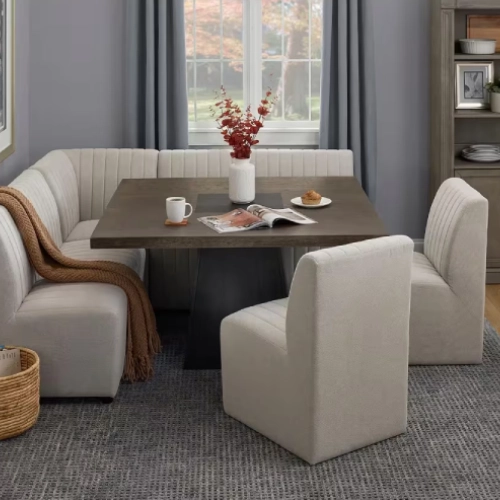
The range covers sofas and sectionals, mattresses, bedroom sets, dining and home office furniture, plus clearance stock through the outlet stores.
Complaints are not evenly spread across that range. Upholstered furniture dominates, with broken frames, squeaking, and cracked or discoloured leather raised repeatedly. Case goods attract complaints about misaligned cabinet doors. Dining and office furniture appear far less often.
If you are weighing a purchase here, the category you are buying matters more than the retailer's overall score.
Stage Three: Delivery, Where It Breaks
| Delivery, the main friction point | What is reported |
| Company claim | Guaranteed 3 day delivery |
| Reviewer experience | Delays of weeks or months |
| Also reported | Missed and rescheduled slots |
| Also reported | Items arriving damaged |
| Also reported | Delivery fees charged on defective items |
A published 3 day delivery claim against reported waits of weeks.
Delivery is the single biggest source of friction, and it is also the exact point where the two review records stop describing the same company at all.
The company page carries a guaranteed 3 day delivery claim. Reviewers on the critical platform describe delays of weeks or months, repeatedly missed or rescheduled slots, cancelled orders and furniture arriving damaged. Several also report being charged a delivery fee on items that arrived defective.
We should be fair about what that does and does not prove. Those are unverified individual accounts, and a chain delivering at this scale will generate failures in absolute numbers even at a good success rate. What it does tell you is that delivery is the stage to pin down in writing before you sign anything.
Stage Four: When Something Goes Wrong
| Protection plans and returns | What reviewers report |
| Plans offered | Mattress, furniture, Platinum |
| Common complaint | Claims denied or unanswered |
| Stated reason | Coverage narrower than understood |
| Published return policy | Online only items, free returns |
| Reported in store experience | Restocking fees, refused returns |
The protection plan is the most disputed part of the whole transaction.
This is the weakest stage. It is also the one we would read most carefully before handing over a card, because it is where a cheap mistake becomes an expensive one.
Mattress, furniture and Platinum coverage plans are offered. The recurring complaint is not that claims are slow, it is that buyers say the coverage turned out narrower than they understood at the point of sale, with claims denied or left unanswered.
Returns show a similar pattern. The published policy says items available only online are eligible for free returns, while reviewers describe restocking fees and refused returns on in store purchases. Those two things can both be true, which is exactly why the in store terms are worth asking about explicitly.
Customer service complaints follow the same shape, with calls ending abruptly and reviewers passed between departments.
So Why Do the Scores Disagree?
| The two review records | Platform A | Platform B |
| Score | 4.4 out of 5 | 2.1 out of 5 |
| Reviews | 65,236 | 891 |
| Five star | 82% | 23% |
| One star | 9% | 66% |
| Sample size against the other | 73.2 times larger | 1.4% as large |
| Gap between the two scores | 2.3 points | - |
4.4 from 65,236 reviews against 2.1 from 891.
Now the headline. One platform shows 4.4 out of five from 65,236 reviews, with 82% at five stars and 9% at one, while the other shows 2.1 out of five from just 891 reviews, with 66% at one star and only 23% at five. Same company. Same period.
That is a 2.3 point gap on the same business. The larger sample is 73.2 times the size of the smaller one, so this is not a case of one tiny sample distorting things.
The Mechanism, Not the Conspiracy

| Why two records differ this much | The mechanism |
| One platform | Company invites customers to review |
| The other | Customers arrive on their own |
| Who tends to arrive unprompted | People with a problem |
| Paid subscription on the larger one | Yes |
| Replies to negative reviews there | None, per the platform |
How a review is collected shapes what it says.
The explanation is structural and it is worth understanding, because it applies to every retailer you research, not just this one.
On the higher scoring platform the company invites customers to review, which means the sample is drawn from everyone who bought. On the other, customers arrive unprompted, and people rarely go looking for a review form after a delivery that went fine.
Two further details are worth stating plainly. The larger platform lists the profile as carrying a paid subscription, and it also notes the company has not replied to negative reviews there. Neither of those invalidates the 4.4, and inviting reviews is a normal and permitted practice, but both are context the score alone does not give you.
Our reading is that the truth is not the midpoint of 4.4 and 2.1. It is that most transactions go fine and the ones that fail, fail in a way people feel compelled to write about.
Before You Buy
| Before you sign | Why |
| Get the delivery window in writing | The 3 day claim is disputed |
| Read the plan exclusions | This is the top dispute area |
| Ask the in store return terms | They differ from online |
| Inspect before the driver leaves | Damage on arrival is common |
| Photograph everything | Claims go smoother with evidence |
Five things to settle before the paperwork.
- Confirm the delivery date in writing, not verbally
- Read the protection plan exclusions page, not the summary
- Ask specifically about in store return terms
- Inspect and photograph before the driver leaves
Final Verdict
| Category | Score |
| Showroom And Sales Staff | 8 / 10 |
| Range And Store Network | 8 / 10 |
| Delivery Reliability | 4 / 10 |
| Product Quality Consistency | 5 / 10 |
| After Sale Support | 3.5 / 10 |
| Overall Score | 5.5 / 10 |
Five and a half out of ten overall, which hides a very uneven experience. Raymour and Flanigan reviews are strongly positive about the showroom and the sales staff, and this is a genuine 79 year old family owned chain with about 145 stores and $1.2 billion in revenue, not a fly by night operation. The problems sit after payment, in delivery and in after sale support, where the protection plan is the single most disputed element. The 4.4 and the 2.1 are both real numbers collected in different ways, and the sensible conclusion is that your odds are good but your recourse is weak, so settle delivery dates and plan exclusions in writing before you sign.
FAQs
Is Raymour and Flanigan a legitimate company?
Yes. It was founded in 1947, is privately held by the same family into a third generation, and reported $1.2 billion in revenue with 5,000 employees as of 2021.
Why are the reviews so different across sites?
One platform invites customers to review, which samples all buyers. The other collects unprompted reviews, which skews towards people with a problem. The scores are 4.4 and 2.1 respectively.
What do people complain about most?
Delivery delays and damage on arrival, followed by protection plan claims being denied and difficulty reaching someone with authority.
Is the protection plan worth buying?
We cannot tell you that, but it is the most disputed part of the transaction in reviews, so read the exclusions in full before adding it.
What do people praise?
Individual salespeople, consistently and by name, along with the ability to see furniture in a showroom before buying.
Can I return furniture bought in store?
The published policy covers free returns on online only items. Reviewers report restocking fees and refusals on in store purchases, so ask for those terms in writing.
Do you agree with our Raymour and Flanigan Reviews: Walking Through an Actual Purchase review?
Comments (0)
All comments are reviewed and approved by an admin before appearing publicly.
No comments yet - be the first to share your thoughts.
Ask a Question
Got a question about this review or the brand? Ask below - our team answers what we can, and it'll appear here for other readers too.