HTVRONT Auto Heat Press 2 Review: Is This Automatic Heat Press Worth It?
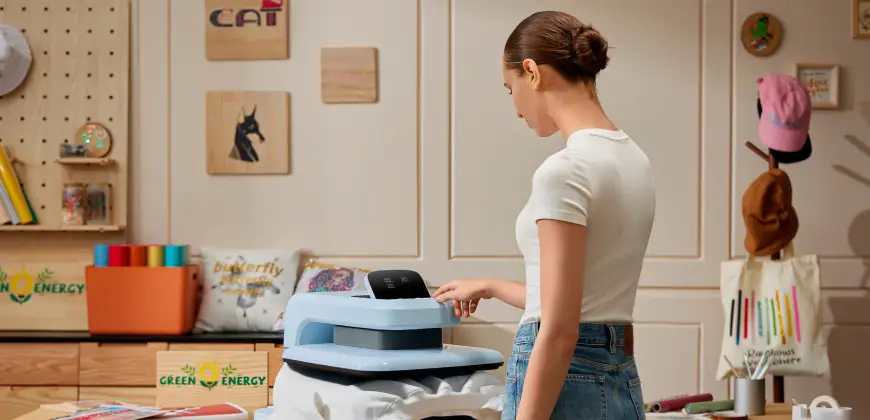
Anyone who has used a manual "clamshell" heat press to process a batch of forty T-shirts knows exactly where the strain is felt: first in the wrist, and then in the shoulder. Furthermore, the results are not always consistent, as the force applied to the lever when pressing the second T-shirt is rarely the same as that applied by the time you reach the thirty-eighth. Uneven pressure is, in fact, one of the primary reasons a heat transfer design might peel off prematurely.
HTVRONT has spent the last few years developing equipment specifically for this type of user: someone running a small-scale textile customization business from a room in their home, rather than from an industrial production facility. The company offers heat presses, vinyl, transfer sheets, and the necessary consumables; their product catalog is priced affordably for hobbyists and small-scale entrepreneurs, rather than for large-scale factories.
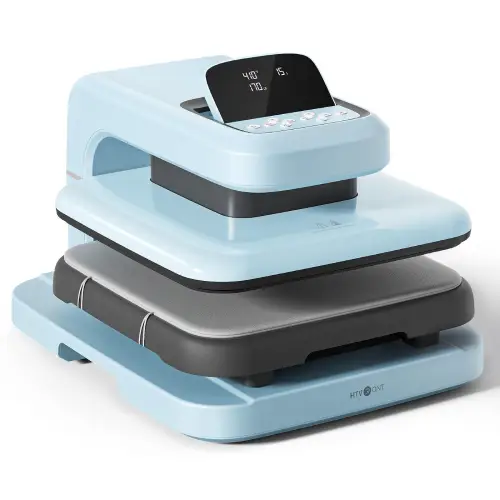
The "Auto Heat Press 2" is the brand’s automatic "clamshell" heat press. The unit handles closing, applying pressure, and opening entirely on its own; it allows for digital pressure adjustment (between 40 and 170 pounds) and features a pull-out tray that keeps hands safely away from the heated platen. HTVRONT markets this product to beginners, craft enthusiasts, and small textile customization businesses.
Determining whether this translates into a simpler, more consistent pressing process—and identifying the specific type of workshop for which it is best suited—requires a more in-depth analysis than what a simple technical specification sheet can provide. In the following sections, we will examine the machine, its settings, its price, and the experiences of users after months of operation.
Highlights
- HTVRONT manufactures heat presses, vinyl, and transfer materials designed for craft enthusiasts and small apparel businesses; their "Auto Heat Press 2" model is an automatic, clamshell-style heat press.
- The press closes, applies pressure, and opens on its own, eliminating the need to operate any levers or handles.
- Pressure is adjusted digitally—ranging from 40 to 170 pounds—removing the need for manual application.
- It features a pull-out tray that allows for convenient placement of garments, away from the heated platen.
- Setup is simple and ideal for beginners: it operates using a standard 120V power outlet and does not require the use of apps or the creation of an account.
- Its 15 x 15-inch (approx. 38 x 38 cm) platen allows for a standard front-side print on adult-sized garments in a single pass.
- The temperature can be adjusted between 210°F and 410°F (approx. 99°C to 210°C), and the timer can be set for durations ranging from 1 to 999 seconds.
- It is compatible with heat transfer vinyl (HTV), sublimation, heat transfer paper, printable heat transfer vinyl, and DTF (Direct-to-Film) technology.
- HTVRONT covers all shipping costs (both ways) for warranty replacements within the 12-month coverage period.
Why you can trust us
Our mission is to help you make better, more informed purchasing decisions.
Our team spends hours researching, consulting with medical experts, gathering insights from specialized professionals, reviewing customer feedback, and analyzing products—all to provide you with the information you need.
Analysis of the HTVRONT Auto Heat Press 2
The term "automatic" can encompass many aspects in this category; therefore, it is worth clarifying exactly which functions the machine performs on its own. The HTVRONT Auto Heat Press 2 closes via a motorized mechanism, applies the pressure pre-set by the user, maintains it for the specified duration, and opens automatically once the cycle is complete.
Below, we examine its four most important features, the practical application of its settings, its price, user feedback, and the types of users for whom it is best suited.
Unique Features
The operation of this machine can be summarized in nine key aspects. The first four represent the primary reasons why users choose the Auto Heat Press 2, while the others cover the heat platen, the heating system, and other practical details for daily use.
1. Automatic Pressing: Autonomous closing, pressure application, and opening
The heat platen lowers on its own, maintains pressure for the set duration, and rises automatically when the timer reaches zero. A motor manages the entire cycle; therefore, user involvement ends once the garment is positioned and the start button is pressed. There is no need to pull any levers or exert physical force to operate the press.
The press does not remain closed while waiting for the user to return, allowing them to step away during the cycle to prepare the next garment. This significantly reduces physical exertion during long work sessions.
2. Digital Pressure Control: 40 to 170 pounds
Pressure is adjusted via a numerical value on the control panel, eliminating the need to calculate it manually using a lever. The range spans from 40 pounds—suitable for delicate tasks, such as sublimation on thin materials—up to 170 pounds for more demanding transfers, such as DTF.
In a manual press, pressure depends on the force applied by the user, which may decrease over the course of a workday. Digital adjustment helps minimize this variable, provided that the recommended temperature, time, and pressure settings for each material are followed.
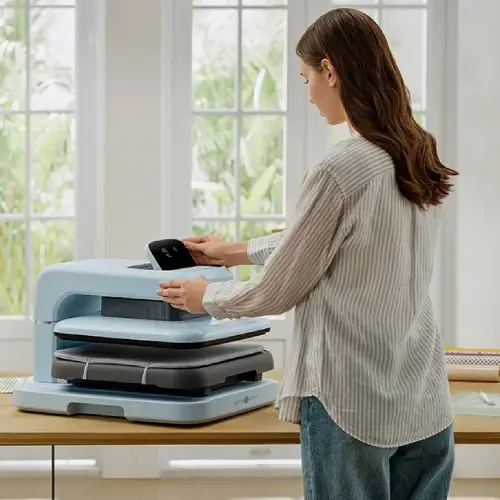
3. Pull-out Tray: Keeping hands away from the hot platen
Instead of requiring the user to work beneath a platen that reaches 400°F (approx. 204°C), the bottom base slides outward on a tray system. The garment is positioned comfortably on the outside, the tray is slid back in, and the cycle begins. It is much easier to align a garment correctly when you have a full view of it; furthermore, your hands remain away from the hot surface during the phase when they would otherwise be most exposed to the heat.
4. Simple setup, ideal for beginners and small businesses
The setup involves just three parameters: temperature, time, and pressure. Manufacturers of transfer materials typically provide these three values for each of their products. Simply enter them into the control panel, position the T-shirt, and press "start."
The machine operates by plugging into a standard 120V household power outlet, so no special electrical installation is required. Additionally, it does not need any app or user account to function. For home crafters looking to upgrade from a manual press, or for small apparel businesses handling batch orders, the learning curve is very short.
5. 15 x 15-inch heat platen
The platen measures 15 x 15 inches—a size designed to accommodate most front-facing prints on adult garments. A standard 11 x 14-inch transfer fits perfectly with room to spare around the edges, meaning the T-shirt only needs to be positioned once, and the job is complete upon removal. Larger prints—such as those for the back of a garment—and extra-large designs can also be processed in a single pass.
6. Temperature range of 210°F to 410°F and a timer from 1 to 999 seconds
The temperature can be adjusted between 210°F and 410°F—a range that covers everything from the lower temperatures required for sublimation to the higher temperatures needed for HTV (heat transfer vinyl) and DTF (direct-to-film) materials. The timer allows for settings ranging from 1 to 999 seconds, accommodating both quick-fix applications and longer curing processes. Temperature, time, and pressure are configured independently via the control panel.
How the settings work in practice
A technical data sheet indicates a machine’s nominal capacity. However, what truly matters is how those values perform during the actual work process; below, we explain the function of each setting and the results they yield.
Warm-up time
In January 2026, the New Atlas team tested the machine and measured the timing. Starting from a cold state, the platen reached 305°F (152°C) in three to four minutes, and hit its maximum temperature of 410°F (210°C) in five and a half minutes. For a workshop that performs pressing in sessions—rather than continuously—this represents the time elapsed between turning on the machine and beginning work on the first garment; essentially, it’s the time it takes to go grab a coffee and return to find the press ready for use.
Setting up a job
To run a cycle, three values must be defined. Temperature and time are determined based on the instructions for the transfer material, which are typically provided by the manufacturers of the vinyl or film. Pressure is the factor that distinguishes this machine from a manual press: with a manual "clamshell" press, pressure is not a precise value, but rather depends on the force applied to the lever each time.
By establishing these three parameters as numerical values, you can repeat a job the following week using the exact same settings. A workshop that has already determined the optimal parameters for its standard heat transfer vinyl (HTV) does not need to conduct new tests every time it returns to that job.
More consistent pressure throughout production
If a design begins to peel at the corners after several washes, the first things to check are the temperature, time, and pressure. Since temperature and time have always been configurable settings, errors involving them are rare. Pressure, however, tends to vary; with a manual press, it depends on the weight and force applied by the operator—factors that may diminish over the course of a long workday.
The ability to program the pressure helps eliminate one of the primary sources of variability between applications, provided that the recommended temperature, time, and pressure settings for the specific material are followed. Those who have switched from a manual press to this type of machine often highlight the reduction in physical exertion as the most significant change.
Processing a batch
Consider, for example, an order of thirty t-shirts for a team that must be ready by Monday. With a manual press, this entails 30 cycles—positioning the item, closing the press, leaning in, maintaining pressure, and opening it—with the operator required to remain at the machine for every single cycle. In this case, once the platen slides back, the cycle proceeds automatically; this allows that time to be used for preparing the next transfer. Many owners describe their workflow in exactly this way: the press operates alongside them, without the need for someone to remain constantly stationed over it.
Brand, Warranty, and Support
HTVRONT is a legitimate company that sells heat presses, heat-transfer vinyl, DTF (Direct-to-Film) printing supplies, and related equipment through its own website, htvront.com, as well as via Amazon and Walmart. The "Auto Heat Press 2" model has reviews across all three platforms, and its product page provides detailed specifications, including temperature range, pressure range, power (wattage), dimensions, and weight. In January 2026, New Atlas also reviewed this heat press and published its measured heat-up times.
The equipment comes with a 12-month warranty from the date of purchase for units bought through the official HTVRONT store. In the event of an approved defect claim, HTVRONT will replace the heat press with a new unit or a functionally equivalent model, covering shipping costs in both directions. To file a claim, you must provide your order number and a video demonstrating the defect.
Standard shipping via htvront.com is free on orders over $49. Orders are processed within 48 hours and typically arrive within four to seven business days; this service is available for physical addresses within the contiguous 48 United States. Priority shipping reduces processing time to 24 hours and transit time to three to five business days, for an additional fee of $25.
Where can I purchase the HTVRONT Auto Heat Press 2?
The press is sold directly through htvront.com; purchasing it there activates the 12-month warranty, as HTVRONT’s warranty terms cover equipment purchased from their official store. Orders are processed within 48 hours via standard shipping and arrive four to seven business days later; consequently, the total delivery time is typically six to nine business days to your doorstep.
It is also available on Amazon and Walmart for shoppers who prefer using platforms they are already familiar with. Orders placed on htvront.com are shipped to physical addresses within the contiguous 48 United States; shipping to P.O. boxes is not supported.
Frequently Asked Questions about the HTVRONT Auto Heat Press 2
What materials does it work with?
The press is compatible with heat transfer vinyl (HTV), sublimation, heat transfer paper, printable heat transfer vinyl (printable HTV), and DTF. Each material requires specific temperature, time, and pressure settings, which are provided by the manufacturer.
How long does it take to heat up?
Independent tests conducted by New Atlas indicated that, starting from room temperature, the machine takes between three and four minutes to reach 305°F (152°C) and five and a half minutes to reach its maximum temperature of 410°F (210°C).
Does it require a special power outlet?
No. The device operates on a standard household electrical connection (120 V, 60 Hz) with a power consumption of 1500 W; therefore, it can be plugged into a conventional power outlet.
Do you agree with our HTVRONT Auto Heat Press 2 review?
Comments (0)
All comments are reviewed and approved by an admin before appearing publicly.
No comments yet - be the first to share your thoughts.
Ask a Question
Got a question about this review or the brand? Ask below - our team answers what we can, and it'll appear here for other readers too.